

Content note: this post describes questions about suicide, self-harm, and sexual orientation.
On Friday, December 12, I was told to come in on Tuesday, and we would resolve everything that had happened over the last week. I asked whether that included the EEOC issues. I was told no. It would just be about the coworker who filmed me.
So on Tuesday, December 16, 2025, I walked in thinking this was about a video.
It wasn’t.
The First Question
I was taken into a room with two of the agency’s special agents. The first thing they asked me was whether I was gay.
Not about the video. Not about the hallway. Whether I was gay.
Then they asked who my lawyer was. They asked who my therapist was. They said they needed a release for my medical records for the case. Not one record. My entire medical file.
What do my sexual orientation and my entire medical file have to do with being filmed in a state truck, or with years of being bullied at work?
Four Years in One Sitting
They asked me to go through everything from April 2022 to that morning. I started at the beginning. Before I even reached July 2024, they told me I seemed “focused on” the district administrator.
She was the person I had been reporting for years, and one of the two supervisors named in my EEOC charge. Of course the story was about her.
At one point, one of them brought up that I liked the TV show Criminal Minds, as if that meant something.
They asked me, directly and more than once, whether I wanted to hurt myself. They asked whether I wanted to hurt the district administrator or anyone else.
They asked whether I owned a gun. I told them I have never owned a gun, and I never would.
I told them no. I told them what I actually wanted: for the truth to be told, for the people who lied to admit it and face accountability, and for a transfer away from a hostile environment.
When an employee reports harassment and asks for accountability, why is he the one being asked whether he’s dangerous?
“The Last Time You Thought About Death”
One question I want on the record exactly as it happened.
They asked me the last time I had thought about death.
I answered honestly. I told them about a night I was driving home when a delivery truck took a curve wide and fast. If I hadn’t slammed on my brakes and pulled to the side of the road, it would have hit me head-on. That was the last time I had thought about dying: how close I came that night.
Then I told them plainly: I am not going to kill myself or anyone else. All I want is for the people who lied to tell the truth and face justice for what they did.
That is the answer they got. Hold on to it, because on Wednesday you’ll see what the agency’s letter did with it.
How does a near-miss on the highway become evidence that someone is a danger to himself?
Write It Down Before You Leave
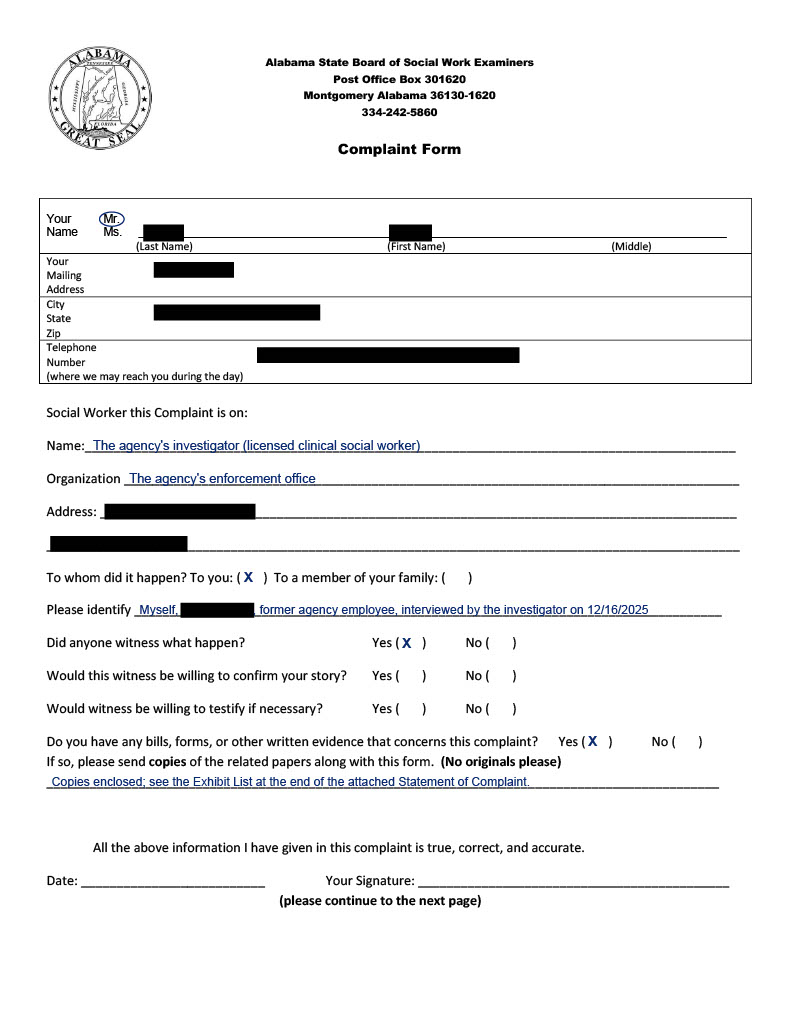
By 9:18 that morning, I had written down what happened in that room and sent it to my attorney.
It records that I was questioned about four years of my employment, that most of the questions were about the district administrator, and that I was asked repeatedly whether I wanted to harm myself or anyone else. It records that I told them my goal was the truth, accountability, and a transfer. And it records that at no point did I express any intent to harm myself or anyone else.
When my statement says I was questioned about my depression and “thoughts of suicide” and answered honestly, this is what it means. They asked. I told them about a truck on a dark curve, and I told them no.
I ended that statement with the concern I still have: the focus had shifted from investigating the harassment I reported to questioning my mental state.
Can Your Employer Demand Your Medical Records?
Under the Americans with Disabilities Act, an employer can ask a current employee disability-related questions or require a medical exam only when it is job-related and consistent with business necessity. In general, that means the employer needs objective evidence that a medical condition is keeping the employee from doing the job or makes him a direct threat. Any medical information it gets has to be kept confidential.
If your employer asks for your medical records:
- Ask what the request is based on, and ask for it in writing.
- Ask who will see your records and how they will be stored.
- Write down who asked, when, and exactly what they said.
The EEOC explains your rights under the ADA at eeoc.gov/disability-discrimination.
2:30 p.m.: Sign Here
At 2:30 that afternoon, I was called back in. The agents had a letter placing me on mandatory leave, charged to my annual leave until it ran out and unpaid after that.
They started going over claims that I was suicidal and a threat. I cut them off. I told them I did not believe they had come there to honestly do anything.
One of the agents answered: “You don’t know who I have talked to, and I am well qualified to diagnose you.”
He was there as a special agent, running an investigation for my employer. I’ve since learned he holds a clinical social work license. But no one in that room examined me as a clinician, and no one told me the interview was an assessment of me.
I was told to sign the letter. I was not given time to read it, and I was not given a copy. Next to my signature, I wrote: “only I received / do not agree.”
Then they made me clean out my office while they watched. I was treated like a criminal. The agent who had opened the morning by asking whether I was gay tried to take my personal phone.
As I walked out to my car, they told me they were concerned about me.
Think about that. That morning, they had asked me over and over whether I wanted to hurt myself or anyone else. That afternoon, they had handed me a letter claiming I was suicidal and a threat. If they believed a word of it, you would expect them to do something: call someone, send a welfare check, make sure I got home safe, check on me in the days that followed. Nine days before Christmas, a man they had just described as a danger to himself was sent home alone with a box of his things.
Nobody did anything. I put my things in my car and drove away. I have not been back to that office since.
If Tuesday was supposed to resolve everything, why did it end with me carrying my things out to my car? And if they truly believed I was a danger, why did no one lift a finger once I was out the door?
I didn’t get my own copy of that letter until December 20. On Wednesday, I’ll post it, along with the response I sent. That entry is “A Deadline That Passed Before the Letter Arrived.”
If you’re carrying something heavy right now, a therapist, doctor, or someone you trust can help you carry it. If you’re in crisis, call or text 988.
The record continues.
About this record: The events in The Foundation are documented in dated records and are consistent with statements I have given under penalty of perjury to the EEOC. Names are withheld; job titles are used instead. Commentary and opinions are my own.
For journalists, researchers, and advocates: If you are covering workplace bullying or public-employee accountability and need documentation or more detail, contact me at 9IX@9inthman.com.




Leave a Reply