
In Part One, I laid out the rules that come with the investigator’s license and set them next to what happened in that room on December 16, 2025. I ended with a question: what is a license for, if no one enforces the rules attached to it?
This is what I did next.
What the Board Told Me
When I first contacted the state social work licensing board, I was told more than once that it had no jurisdiction, because the investigator was working for the agency at the time.
When I asked again, the person I spoke with went further. Enforcing the code, I was told, was the employer’s responsibility. And the board doesn’t really enforce the code of ethics in that setting.
The employer. The same agency that put me on unpaid leave the afternoon he told me he was qualified to diagnose me.
What I Filed
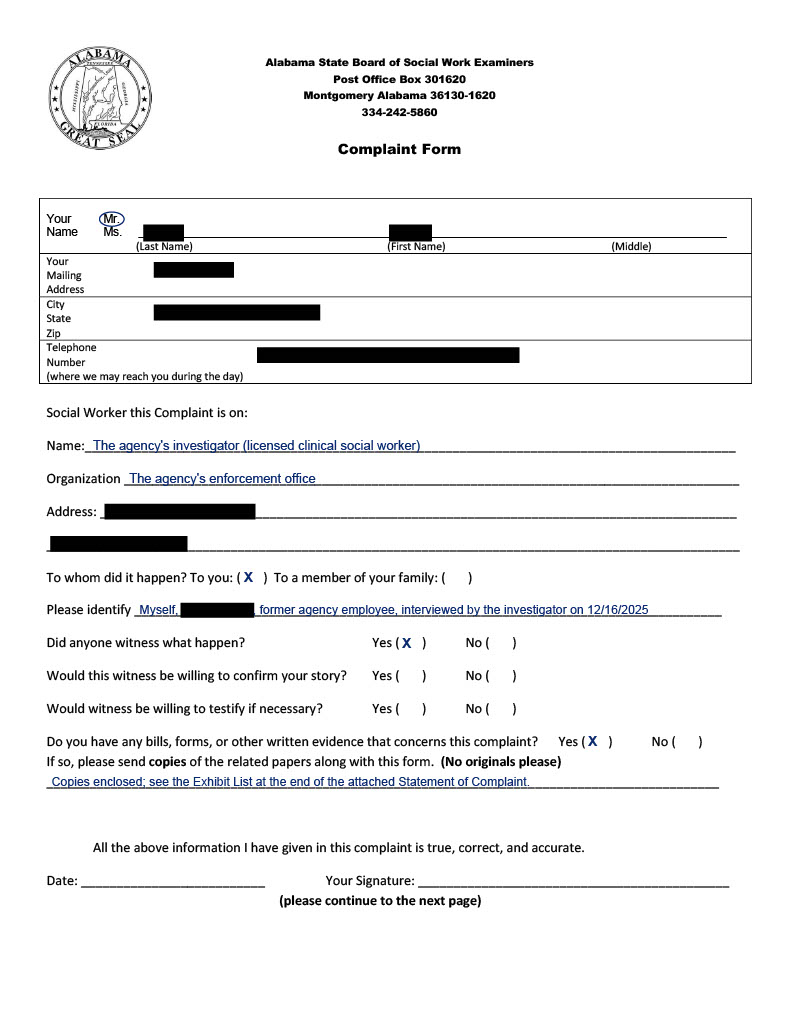
In late October 2026, I mailed the board its official complaint form with a signed statement attached. The full complaint is below. My name and address are blacked out, the agency isn’t named, and the people involved are identified by job title only.
The complaint does three things.
- It lays out what happened on December 16, 2025. HR had told me it would only deal with the complaint I had just filed about the coworker who threatened me, and the two investigators said they were there to ask me a few questions about that complaint. Instead, I was asked whether I was gay and who my lawyer and therapist were, told to sign a release for my medical files, and told I was being diagnosed.
- It answers the jurisdiction question head-on. The board’s own rules say a social worker’s private conduct is a personal matter except when it compromises professional responsibilities. Claiming the authority to diagnose someone isn’t private conduct.
- It ties the conduct to specific rules. Misrepresenting qualifications, working beyond competence, failing to act impartially, and failing to prevent discriminatory practices are each matched to a numbered section of the board’s standards.
It also points to the 2023 federal case you read about in The Same Agent, Twice. The complaint doesn’t ask the board to rely on any finding in that case. It only asks the board to consider whether there’s a pattern.
Why I Filed Anyway
I already had my answer, so why file?
Because a phone call leaves no record. A form does. If the board decides this isn’t its business, I want that decision in writing, with a date on it, sitting in the same file as everything else.
And if the board decides it is its business, I want the record to be complete when it looks.
What the Board Said
As of this post, the board hasn’t responded in writing. When it does, I’ll add its answer here, whatever it says.
What This Shows
Every office I contacted gave me a reason it couldn’t act. This one gave me two: not our jurisdiction, and the employer’s job.
The employer is the agency. The agency is the one that put me on leave.
You decide what that circle means.
If you’re facing something like this, start with Don’t Fight Alone.
The record continues.
About this record: The events in The Foundation are documented in dated records and are consistent with statements I have given under penalty of perjury to the EEOC. Names are withheld; job titles are used instead. Commentary and opinions are my own.
For journalists, researchers, and advocates: If you are covering workplace bullying or public-employee accountability and need documentation or more detail, contact me at 9IX@9inthman.com.




Leave a Reply