

Content note: this post discusses workplace harassment and its effect on mental health.
Follow the bill as it moves: get updates on the Alabama Healthy Workplace Act →
Every model I build starts with the base. If the base is warped, nothing you put on top of it sits right. You can paint over it. You can weather it. The flaw is still in every piece you add.
Alabama built its workplace protections on a base with a beam missing. No law in this state stops a boss from bullying a worker. I found that out the hard way.
I’m done waiting for someone else to fix it.
Is Workplace Bullying Illegal in Alabama?
No. Workplace bullying is not illegal in Alabama unless it targets a protected trait, like sex, race or disability, or punishes you for making a complaint. If a supervisor screams at you, isolates you and mocks you every day, and none of it ties back to one of those, Alabama law has nothing to say about it.
Here is the line the law draws today:
- Illegal: harassment because of a protected trait, and retaliation for a complaint.
- Legal: almost everything else, no matter how often it happens or how much damage it does.
That gap is not small. In its 2024 national survey, the Workplace Bullying Institute found that about a third of American adults say they have been bullied at work, and most of the people targeted end up losing their jobs.
Alabama tried to close the gap once. In 2015, a state senator introduced the Healthy Workplace Act, Senate Bill 195. It never passed.
The Damage Came After the Complaint
I worked as an Engineering Assistant at the Alabama Department of Transportation from April 2022 to March 2026.
While I was still on probation, my district administrator called me an idiot on speakerphone to one of her own superiors. Later, my office became an 8×4 storage room, and she called it punishment. Coworkers called me gay. One supervisor said he’d believe it if a man with my name were arrested for child pornography.
In November 2024, I filed a charge with the EEOC. Here is what happened next:
- The agency left me under the same two supervisors for about 16 months.
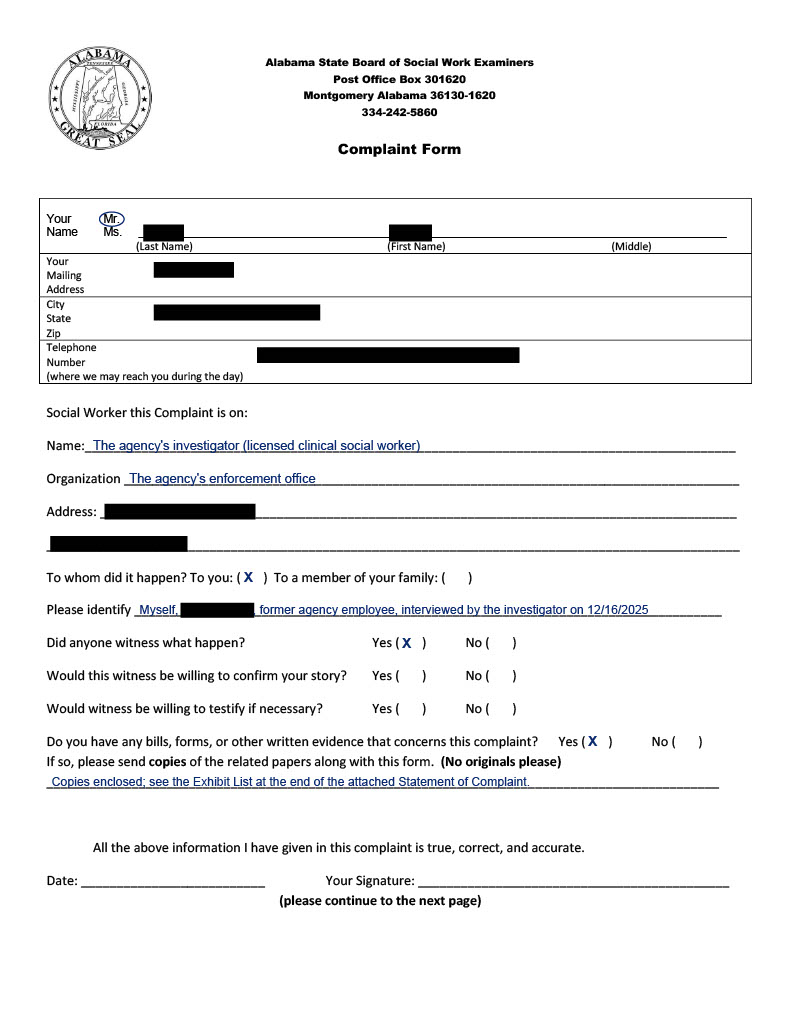
- After another complaint in December 2025, two agency investigators questioned me, and I was put on unpaid leave over a mental health claim I dispute.
- The fitness-for-duty requirement to come back changed four times.
- My health insurance was canceled retroactively, and I didn’t find out for a month.
- In March 2026, I was fired.
Then the agency gave different stories to the State Employees’ Insurance Board, the Department of Labor, the State Personnel Board and the EEOC.
Read that list again. Bullying started it. The complaint process finished it. And the 2015 bill never touched that part.
I’ve been documenting every step in The Foundation.
What the Alabama Healthy Workplace Act Would Require
I took the 2015 bill and rebuilt it around what went wrong for me. The updated draft would:
- Separate you fast. Within five business days of a complaint, the people you named could no longer supervise you, discipline you or control your workspace.
- Bring in an outside investigator. No one you reported, and no one who reports to them, could run the investigation.
- Stop fake assessments. Investigators couldn’t play therapist. An agency would need a licensed clinician’s written assessment before putting you on leave over your mental health.
- Put the rules in writing. Fitness-for-duty requirements would be set in writing, with real time to meet any change.
- Protect your insurance. At least 15 days’ notice before your pay or coverage changes, and no retroactive cancellations.
- Require the truth. Agencies couldn’t make false statements about you to other agencies, and they’d have to send you a copy of what they told the unemployment office.
- Report every year. State agencies would publish how many complaints they received and what happened to them.
Who Pays When a State Agency Gets It Wrong?
You do.
Under Alabama Code § 25-4-149, the State pays its own workers’ unemployment out of the same money that pays their salaries. Every trained state worker who gets pushed out and qualifies for benefits is paid from the agency’s own budget, up to $3,850 a claim at today’s maximum.
That’s before the cost of replacing that worker, which research puts anywhere from about a fifth of a salary to double it. Before the lawyers. Before the settlements. Before the claims on a state-funded health plan.
So here is my question for every agency head in Montgomery: why are taxpayers paying to clean up a problem a five-day rule could prevent?
Why 2027 Is the Year
Three things changed this week.
Alabama elected a new governor who promised to make state agencies publicly account for their performance. A new Legislature organizes in January. And the public is already there: in that same 2024 survey, 87% of Americans said they support a law like this.
This isn’t a left bill or a right bill. It’s about honest government and keeping trained people on the job. Those are Alabama values.
What You Can Do This Week
- Email your legislators. Find them with Find My Legislator and send one sentence: “Please support the Alabama Healthy Workplace Act in the 2027 session.”
- Read the bill and the money brief. Download the Alabama Healthy Workplace Act draft and Why It Pays for Alabama.
- Share this post with anyone who works for the State, or anyone who has been where I was.
- Tell your story. If this happened to you, email me at 9IX@9inthman.com. The more of us legislators hear from, the harder we are to ignore.
- If you’re in it right now, start at Don’t Fight Alone.
I’m taking this straight to the people with the power to fix it: my own legislators, the committee that oversees ALDOT, the incoming governor’s team and Alabama’s members of Congress.
Alabama left a beam out. Let’s put it back.
The events in this post are ones I have reported under oath to the EEOC. Journalists, researchers and advocates can reach me at 9IX@9inthman.com.



Leave a Reply