

Count the days with me.
Tuesday, December 9: I sent HR a written report about being filmed and the afternoon of yelling in the hallway. Friday, December 12: I got a call telling me not to come in on Monday.
Three days. Here’s what happened in between, including a mistake of my own that I’m going to show you rather than hide.
December 10: Interviewed by the People I’d Reported
The first sign anyone had read my report came on Wednesday, December 10. I was called into a meeting about it.
Across from me sat the district administrator, one of the two supervisors named in my EEOC charge. Beside her sat the construction side manager who had watched the video, laughed, and made comments mocking me.
Those were the two people reviewing my complaint.
I tried to explain why this could not work. She was the same person who had called me gay in front of a work crew. Her answer was, “I never thought you were gay.” Not “I never said that.” I never thought it.
She kept talking over me and would not let me finish. Before the meeting ended, she told me that from now on, I was not to report anything to anyone but her and the assistant district administrator, the other supervisor named in my EEOC charge.
What is a workplace investigation worth when the person running it is under federal investigation herself?
December 11, 8:24 a.m.: The Email I Didn’t Proofread
The next morning, I wrote to HR at the agency’s head office. I’m going to be upfront about this email, because the agency certainly will be.
I took Thursday and Friday off as sick days. After Wednesday’s meeting, I was shaking and upset. It was clear to me that nothing was going to be done about what happened, and this had gone on far too long. I felt I had to get something in writing fast, before it was shut down and the coworker who filmed me got away with it.
So I used an AI tool to help draft the email. Instead of taking a breath, calming down, and reading it over, I sent it. That’s on me. It shows.

Look at the brackets. The second sentence still says “[Insert Date of Previous Email, e.g., Tuesday, December 9th].” The fourth paragraph says I “felt compelled to yell things” and needed to quit “before I did something to [mention who, if you did in the original email, otherwise keep it vague like ‘myself’ or ‘to others’].”
Those brackets aren’t my words. They’re instructions from a template that nobody filled in, least of all me. And that paragraph starts with “I also reported an incident,” pointing back to my December 9 report, the one you saw on Wednesday. That report says plainly who was yelling in the hallway and who said she “may need to quit before she does something.” It wasn’t me.
Here’s what the email does say, in words I stand behind. The harassment was hurting my mental health. I did not feel safe. And I asked HR to open a formal investigation and make sure it was handled by someone who could look at it objectively, not the district administrator.
When I wrote that this was affecting my mental health, I meant exactly that. It meant the stress was overwhelming me. It meant I was upset, I felt attacked, and I was shaking so badly I couldn’t stop. It did not mean I wanted to hurt myself or anyone else, and nothing in that email says so.
That’s an employee asking for help.
If an email still contains “[Insert Date of Previous Email],” is it a confession, or a template nobody proofread? And why didn’t anyone pick up the phone and ask?
December 11: The Call
Right after sending that email, I called HR at the regional office.
On that call, I repeated what my December 9 report said about the video and the hallway. I asked that someone other than the district administrator handle the investigation.
Then I told HR something I assumed they already knew: there was an active EEOC investigation into the district administrator, and there had been since November 2024.
She said she didn’t know. She said she would tell her boss.
How does an agency’s own HR not know about a federal investigation into one of its district administrators that had been open for more than a year?
Thirteen Months, No Protection
On December 12, I wrote to my attorney at the time with a statement for the EEOC investigator on my case and told him this needed to be fixed. What I had learned that week was simple: the regional leadership and HR had never been told the EEOC investigation existed.
That explained a lot. Because nobody had been told, nothing had been done to protect me. I was never separated from the supervisors I had filed against. Nobody was watching for retaliation. Nobody took any steps to keep things from getting worse.
And they did get worse. After the December 10 meeting, coworkers started ignoring me. Some refused to take calls from me about work.
Somebody at the agency knew about the EEOC charge. Who decided not to tell the people responsible for protecting me?
Whose Mistake Was It, Really?
By December 2025, I had been living with diagnosed depression for more than two years. I was diagnosed in September 2023, while all of this was going on. In 2024, the diagnosis became major depression and anxiety, and my therapist connected both to the work environment I walked into every day.
For thirteen months after I filed my EEOC charge, the agency kept me working under the supervisors I had filed against. Nobody separated us. Nobody watched for retaliation. The mockery from coworkers went on in the open.
Then, on December 10, the district administrator I had filed against sat across from me to review my complaint and told me she and the assistant district administrator were the only people I could report to. The next morning, still shaking from that meeting, I sent an email I should have proofread.
I own that mistake. But it didn’t happen in a vacuum. It happened after more than three and a half years of being bullied by the people in charge of me and the people working beside me, with nobody stepping in to stop it.
When an employer leaves a worker under the people he reported for more than a year, and his health gets worse, does it then get to point to the effects of that environment as the problem? When does an agency get to use an illness it allowed to grow against the person living with it?
Can an Employer Put You on Leave After You Complain?
An employer can place an employee on administrative leave for legitimate reasons. But if the leave is taken because you reported harassment, filed an EEOC charge, or took part in an investigation, it can be illegal retaliation. When investigators look at retaliation, one of the things they consider is timing: how soon the action came after the protected activity.
The EEOC explains what counts as retaliation at eeoc.gov/retaliation.
December 12: “We Would Resolve Everything”
On Friday, December 12, I got the call. I was being placed on mandatory paid leave for Monday, December 15. I was to come in Tuesday, and we would resolve everything that had happened to me over the last week.
I asked whether that would include the EEOC issues. She told me no. It would just be about the issues with the coworker who filmed me. I said thank you.
Three days after my written report. One day after I told HR about the EEOC investigation. One day after an email asking for help.
The agency may say it was the email that set this off. Maybe it was. If so, look at what they did with it. An employee wrote that he felt unsafe and asked for an objective investigation. Nobody asked what the brackets meant. Nobody asked about the December 9 report the email pointed back to. The answer was leave.
Whether it was the EEOC disclosure, the email, or both, why was the first response to a request for help to send the person asking for it home?
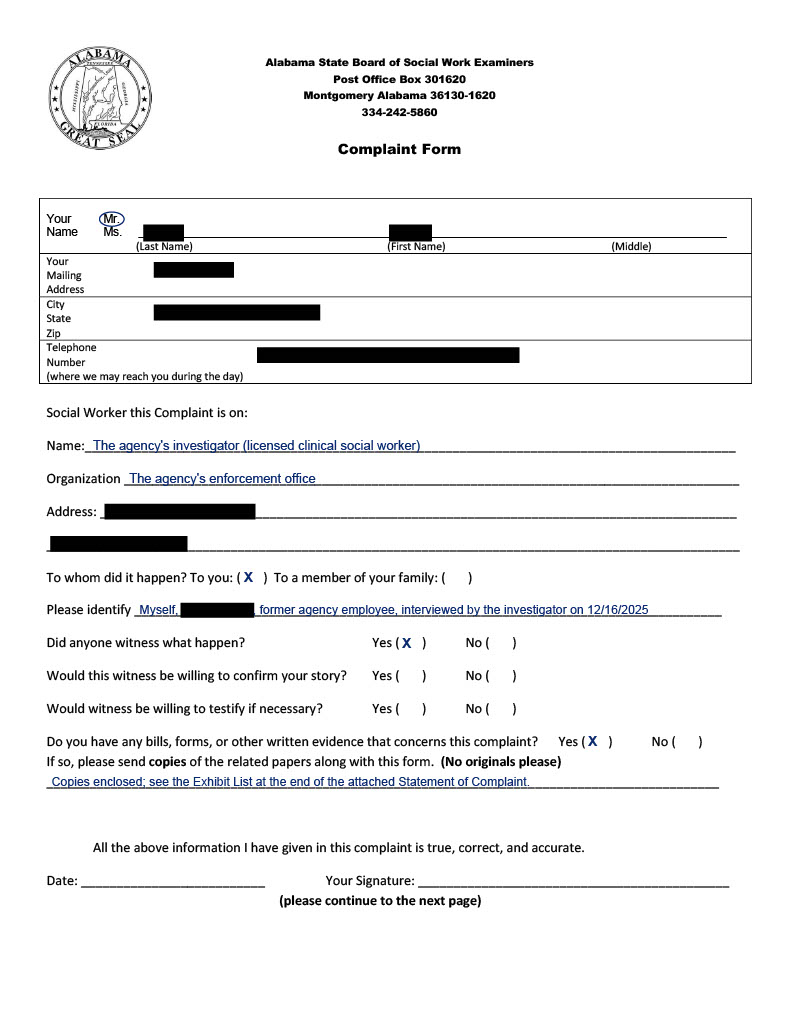
On Tuesday, December 16, I walked in expecting everything to be resolved. On Monday, I’ll post the next entry in this series: “December 16: The First Question Was ‘Are You Gay?’”
The record continues.
About this record: The events in The Foundation are documented in dated records and are consistent with statements I have given under penalty of perjury to the EEOC. Names are withheld; job titles are used instead. Commentary and opinions are my own.
For journalists, researchers, and advocates: If you are covering workplace bullying or public-employee accountability and need documentation or more detail, contact me at 9IX@9inthman.com.



Leave a Reply